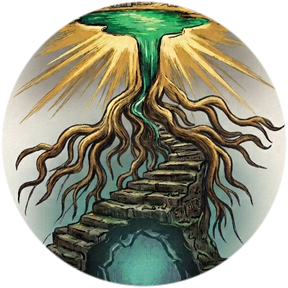
The Age of Springs
Before the first city rose, the world breathed. Mana Springs dotted the landscape —
some the size of a well, others vast enough that entire groves grew around them, fed by
their slow exhalation of power. They were not resources then. Not nodes, not extraction
points, not strategic assets. They simply were: ancient, patient, and largely
indifferent to the small creatures moving around them.
The Fog existed even then, but it was ordinary — thicker at night, thinner near active
Springs, thickest in the unmapped places. Hunters managed it. They built fires at camp
edges, carved waymarks into stone, travelled by day. It was dangerous, not malevolent:
the boundary between the known and the unknown, nothing more.
The first people to truly understand the Springs were the keepers —
scattered, unnamed, belonging to no culture in particular. They noticed the Fog thinned
around a healthy Spring and thickened when one ran cold. They learned to listen. Not to
extract or command, but to witness.
They are still here. The keepers' tradition survives in a single diminished faction — the Root-Sworn — though they would say it isn't diminished, only besieged.
The Arcanate
A civilisation rose, and as civilisations do, it found the Springs and asked not
what are these? but what can we do with them?
The answer was: nearly everything. Channelled properly, Spring mana fuelled forges that
never cooled, fields that never failed, weapons that never dulled. Cities near Springs
grew rich; cities without them piped mana across vast distances through crystalline
conduits. The Arcanate unified all of it into a system of breathtaking sophistication.
Three magical affinities emerged as teachable disciplines in its academies —
fire, which consumed and purified; ice, which preserved
and slowed; lightning, which moved in straight lines and thought faster
than thought. The academies trained specialists. The military deployed them. The Springs
paid for all of it.
What the Arcanate never reckoned with was the keepers' oldest warning:
the Springs are not wells. Wells you drain. Springs you tend.
The Sundering
The Arcanate's final project was the Grand Confluence. The theory was
elegant: if one Spring could power a city, a unified network of every known Spring could
power a civilisation without limit. Every mage, every soldier, every craftsperson drawing
from one shared pool. Two generations of mathematics. One more of engineering.
It failed at the moment of activation.
No one alive knows exactly why. The Convergence has hundreds of competing theories. The
Root-Sworn have a simpler one: the Springs did not agree to it. What is known is
the aftermath. Dozens of Springs went dormant or inverted, releasing wild corrupted mana
instead of clean energy. The conduit network became a highway for the release, destroying
cities that had done nothing wrong. The Arcanate's seat of power ceased to exist by the
end of the first day. Within a season, the empire was a memory.
But the Sundering was not only a collapse — it was a transformation. When Springs
corrupted, something happened to the Fog. It thickened. It spread. It stopped being
merely the absence of light. And from the deepest corruption of the most damaged Springs,
something wholly new came out.
The Fog
The Fog is not weather. It does not answer to wind or season. It is, as most scholars now
understand it, the residue of the Sundering — corrupted mana dispersed into the air
rather than returned to the earth.
It limits vision universally and no one is immune. From open ground you might see thirty
paces before the world disappears; at night, considerably less. It is denser around dying
Springs, old Sundering battlefields and territory the Abyss frequents. It thins near
healthy Springs — a well-kept Spring in active use carves a visible clearing that can
reach several hundred paces.
This is not coincidence. It is causal, and reliable enough that scouts navigate by it: if
the Fog seems thinner ahead, there may be a Spring within reach.
Ways to see further
- Fire — the oldest answer. A torch doubles your range; a bonfire at a camp's edge triples it. Settlements that last keep fire burning at their borders permanently, and treat the fuel as survival expenditure rather than luxury.
- Amplification lenses — machined crystal and Spring-mana, made by the Convergence. Enormously effective, expensive, and hungry for a continuous mana draw. A good lens is worth more than a good sword in most markets.
- The lightning affinity — carries a passive perceptual edge. Lightning-trained mages catch movement in the Fog before it resolves into anything visible.
- Wide-tending — the Root-Sworn method, and no device at all. A cultivated stillness in which the body stops expecting to see and starts expecting to feel. The Fog does not deceive touch or vibration the way it deceives vision. It takes about a decade to learn.
Scouts and the art of the map
Scouting is one of the most valued professions in the world, because the Fog makes
consistent navigation nearly impossible. Landmarks vanish the moment you pass them. A
path clear yesterday may be Fog-thick today if a nearby Spring has weakened.
Scouts answer this by building a framework of the known — cairns, blazed trees, carved
stones, iron stakes in deliberate patterns — and returning with hand-drawn charts. A good
map is never a perfect representation. It's the record of one person's path through
the Fog at a specific time, annotated with what they saw and what felt permanent.
The best ones note not just geography but Fog behaviour: where it was heavy, where it
thinned, and where something moved that the scout chose not to approach.
What Lives in It
Scholars argue constantly about the taxonomy. In practice, four things come out of the Fog.
- Fogborn — evolved entirely inside the Fog since the Sundering. Diminished eyes or none at all; they navigate by vibration and chemical sense. Strong light disorients them, which does not make them safer. Fogborn suddenly illuminated do not flee. They panic.
- Corrupted beasts — recognisable animals that spent generations near corrupted Springs. Limbs in wrong ratios, doubled features, tempers far past their nature. They are not mindless. A corrupted wolf pack driven off once will approach differently next time.
- Abyssal creatures — they do not retreat from torchlight the way Fogborn do, and they coordinate in ways that imply something is directing them.
- The Old Things — creatures that grew very large and very old near powerful Springs before the Sundering. The catastrophe did not kill them. Several persist in the deep Fog: vast, slow presences for whom human settlement is not a relevant concept. They do not hunt. Things in their territory simply die if they are unlucky enough to be noticed.
Dragon graveyards. Not every Old Thing survived. Their remains weather out of open ground — ribs the size of roof-beams — and the Fog lies thin over them. Scouts record these places as carefully as they'd record a Spring. The Ledger pays well for a confirmed graveyard. The Root-Sworn won't camp in one; their Listeners say the land there is still grieving, and should be left to finish.
The Six Factions
The politics of Vale are not a war between good and evil. They're a web of competing
interests, shared history and practical dependency that nobody can afford to walk away
from. The Abyss is the single exception — universally opposed, and not open to
negotiation.